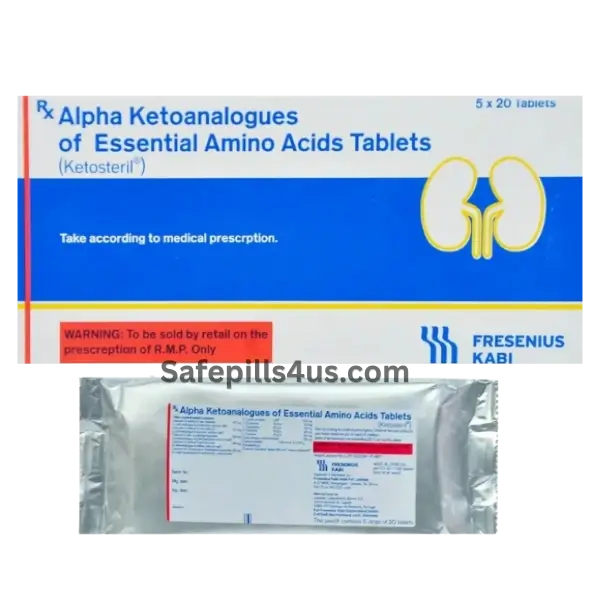
Ketosteril Tablet (Amino Acids) in a Clean, Easy Structure
Ketosteril Tablet (Amino Acids) is a specialized blend of essential amino acids and their ketoanalogues made for people managing chronic kidney disease alongside a controlled low‑protein diet. In simple terms, it helps give your body the building blocks it needs for muscle and nutrition, while generating less nitrogen waste than regular protein. That combination supports better nutritional balance and may help slow the rise of waste products in the blood when used exactly as directed by your healthcare professional.
What this Product is Designed to do
- Support protein nutrition on a low‑protein diet without overloading your kidneys
- Provide essential amino acids and ketoanalogues that your body can convert as needed
- Help reduce nitrogen waste, which can translate to lower uremic toxin load
- Maintain muscle health and overall nutritional status during kidney care
How it Works in Practical Terms
Your body needs amino acids to repair tissues and keep muscles strong. But in chronic kidney disease, high protein intake can push up nitrogenous wastes. Ketosteril Tablet (Amino Acids) uses ketoanalogues—nitrogen‑free “partners” of essential amino acids—that can be converted into usable amino acids inside your body by borrowing nitrogen that would otherwise turn into waste. So, you get support for protein needs with a gentler impact on kidney burden when used with a properly planned low‑protein diet and adequate calories.
What’s inside Each Tablet
- A balanced mix of ketoanalogues of key essential amino acids (such as those related to leucine, isoleucine, valine, and phenylalanine)
- Select essential amino acids (like lysine, threonine, tryptophan, histidine, and tyrosine)
- Calcium salts that help carry certain ketoanalogues
The exact composition can vary by market. Always check your local pack insert for the full ingredient list.
Who Typically Uses Ketosteril and Why it Helps
- Adults with chronic kidney disease following a low‑protein or very low‑protein diet under medical supervision
- People who need to maintain good nutrition and muscle mass while limiting nitrogen waste
- Those whose clinicians want to slow the rise of blood urea and other waste markers by pairing diet therapy with ketoanalogues
If you’re not sure whether Ketosteril Tablet (Amino Acids) fits your plan, ask your nephrologist or dietitian. This product works best as part of a complete kidney care strategy, not as a standalone fix.
How to Take it the Right Way
- Take with meals: Swallow tablets whole during your main meals. Taking them with food helps the body convert ketoanalogues effectively.
- Do not chew: Swallow tablets intact with water.
- Follow your prescribed amount: A common approach is based on body weight and split into multiple doses through the day, but only follow the dose and schedule your clinician gives you.
- Keep calories adequate: A low‑protein plan needs enough calories from carbs and healthy fats to work well. Your dietitian can tailor this for you.
What to Expect Over Time With Consistent Use
- Short term: Better tolerance of a low‑protein diet and steadier energy when your calories are adequate
- Ongoing: Support for muscle maintenance and nutrition; potential stabilization of certain lab markers when used as directed with diet therapy
- Long term: Your care team will track labs like urea, creatinine, calcium, phosphate, and others to see how your plan is working
Results vary by individual, disease stage, and how closely the diet and dosing are followed.
Smart Do’s and Don’ts for Safer Use
Do:
- Take Ketosteril Tablet (Amino Acids) at mealtimes as prescribed
- Keep your dietitian’s low‑protein plan and calorie goals on track
- Attend regular lab checkups for calcium, phosphate, urea, and kidney function
- Tell your care team about every medicine and supplement you use
Don’t:
- Chew or crush the tablets
- Self‑adjust your dose or protein intake without guidance
- Skip meals or cut calories too low—this can undermine the whole plan
- Share your tablets with anyone
Important Safety Notes to Keep in Mind
- Hypercalcemia risk: Because some components are calcium salts, high blood calcium can occur. Your clinician will monitor levels. If you notice nausea, constipation, excessive thirst, confusion, or weakness, contact your provider.
- Drug interactions: Calcium can reduce absorption of certain medicines. Separate dosing from tetracycline or fluoroquinolone antibiotics, iron supplements, or estramustine as advised by your clinician or pharmacist.
- Not for certain conditions: Avoid use if you have high blood calcium unless your clinician specifically directs and monitors therapy.
- Pregnancy and breastfeeding: Use only if your healthcare professional decides the benefits outweigh the risks.
- Children: Safety and dosing for pediatric use depend on local guidance and specialist advice.
How it Pairs With Your Kidney Diet
- Low protein, not low nutrition: Your dietitian will help set a protein target that fits your stage of CKD, then fill in calories from grains, fruits, vegetables, and fats to keep weight stable.
- Sodium and phosphate awareness: Many CKD diets also focus on sodium and phosphate control. Your team may add phosphate binders if needed.
- Hydration and blood pressure: Routine monitoring and medication adjustments are common parts of a broader CKD plan.
Quick Composition Highlights You Can Mention to Your Care Team
- Ketoanalogues of essential amino acids to limit nitrogen load
- Essential amino acids to complete the profile
- Delivered partly as calcium salts, which is why calcium monitoring matters
If you’re comparing brands or generics, bring the exact ingredient panel to your appointments so your clinician can confirm equivalence.
Frequently Asked Questions About Ketosteril
Is Ketosteril a protein supplement?+
Not in the usual sense. It supports amino acid needs with ketoanalogues that create less nitrogen waste than typical protein. It is meant to be used with a low-protein diet, not to replace it.
Do I still need to limit protein while taking Ketosteril?+
Yes. The benefits are tied to a properly planned low-protein diet. Your dietitian will set your daily protein target and calorie needs.
How many tablets should I take each day?+
Dosing is individualized, often linked to body weight and split across meals. Only follow the schedule set by your clinician.
Why must I take it with meals?+
Taking tablets with food helps your body convert ketoanalogues into usable amino acids by using dietary or endogenous nitrogen. This is how the nitrogen-sparing effect works best.
Are there common side effects?+
Possible effects include high blood calcium, mild stomach upset, or constipation. Your care team may monitor labs and adjust treatment if needed.
Can I take Ketosteril with antibiotics or iron?+
Calcium can interfere with absorption of some medicines. Your provider or pharmacist may advise separating doses by a few hours. Always share your full medication list.