Description
How ivermectin works
Parasites need tiny channels in their nerve and muscle cells to move and stay alive.
Ivermectin locks those channels open, the parasite gets paralyzed, and then it dies. That’s it. Your immune system then does clean‑up duty, which is why itching can briefly feel worse as the body reacts to dead parasites especially in scabies and onchocerciasis.
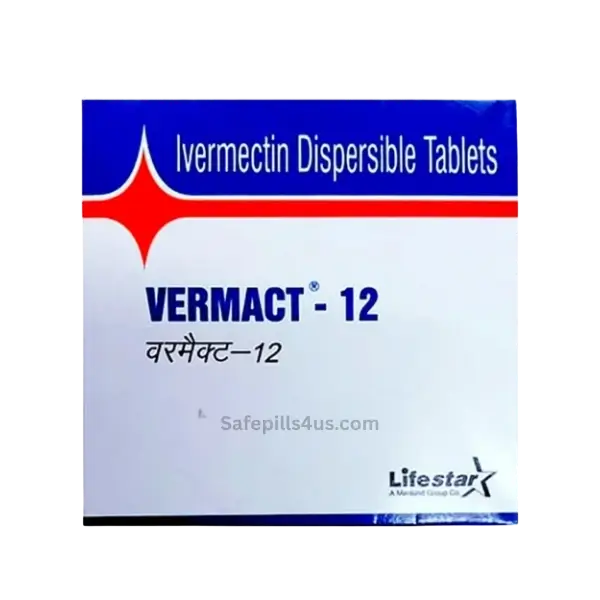
What Vermact 12 mg is used for
Your doctor may prescribe Vermact 12 mg for:
- Strongyloidiasis (threadworm)
- Onchocerciasis (river blindness)
- Scabies, including crusted scabies, when oral therapy is needed or topical therapy isn’t suitable
- Head lice in some cases (usually when other treatments fail or aren’t appropriate)
How to take it
- Take the tablet with water on an empty stomach (typically 1 hour before food).
- Dosing is weight‑based. Your doctor calculates how many tablets you need.
- Take it at the same time of day when possible.
- Don’t split or crush unless your doctor says you can.
Missed a dose? Take it when you remember unless it’s close to the next scheduled dose. Don’t double up.
Typical dosing guidance
- Strongyloidiasis: about 200 micrograms per kg as a single dose; sometimes repeated (for example, after 2 weeks).
- Onchocerciasis: about 150 micrograms per kg as a single dose; repeated every 3–12 months depending on program guidelines.
- Scabies (classic): about 200 micrograms per kg as a single dose, often repeated after 7–14 days. Topical therapy (like permethrin) may be used too.
- Scabies (crusted): multiple doses over several weeks plus topical therapy specialist plan only.
- Head lice: dose is weight‑based and may be repeated (often day 1 and day 8) when oral therapy is chosen.
Example only, not a rule: a 60 kg adult may be told to take one 12 mg tablet for strongyloidiasis. But please don’t calculate this yourself weight, condition, and local guidelines matter.
What to expect
- Many people have no issues and feel normal after dosing.
- In scabies or onchocerciasis, itching or rash can flare briefly as parasites die (a reaction, not a failure).
- For worm infections, your doctor may check stool or blood tests after treatment to confirm cure.
Side effects
Common (usually mild and short‑lived):
- Nausea, stomach upset, loss of appetite
- Dizziness, sleepiness, headache
- Mild diarrhea
- Itching or skin rash (often part of the die‑off reaction)
Less common but serious seek medical help if you notice:
- Severe dizziness or fainting, confusion, seizures
- Shortness of breath, chest pain, swelling of face/lips (possible allergy)
- Eye pain, vision changes (particularly in onchocerciasis)
- Signs of severe reaction in onchocerciasis (Mazzotti‑type): fever, intense itching, swollen/tender lymph nodes, joint pain—call your clinician
Warnings and precautions
- Children: Often avoided under 15 kg body weight unless a specialist prescribes.
- Pregnancy: Generally avoided unless clearly needed—discuss risks vs. benefits.
- Breastfeeding: Ask for advice; timing doses right after a feed may be suggested.
- Liver disease: Use with caution; your doctor may monitor more closely.
- Brain/eye issues: Tell your doctor if you have a history of meningitis, seizures, or eye disease.
- Loa loa risk: If you lived in or traveled to parts of West/Central Africa where Loa loa is found, tell your doctor before taking ivermectin. Rare but serious brain reactions can occur with heavy Loa loa infection.
- Driving/working at heights: If you feel dizzy or sleepy, wait until you feel steady.
Drug and food interactions
Tell your doctor about all medicines and supplements. Important examples:
- Warfarin ivermectin may increase INR extra monitoring may be needed.
- Strong CYP3A4/P‑gp inhibitors can raise ivermectin levels: examples include clarithromycin, erythromycin, azole antifungals (ketoconazole/itraconazole), some HIV boosters (ritonavir, cobicistat), verapamil, cyclosporine.
- Other drugs that make you drowsy (benzodiazepines, opioids, alcohol): may add to dizziness/sedation.
- Grapefruit products: can raise drug levels best to avoid unless your doctor says it’s okay.
Tips for better results
- Treat close contacts in scabies if your clinician recommends it; wash bedding, towels, and clothing in hot water and dry on high heat.
- For head lice, follow nit‑combing and household cleaning advice from your clinician.
- Stay hydrated and avoid alcohol right around dosing—keeps dizziness at bay.
- Keep the follow‑up visit. Tests after treatment confirm that the infection is gone.
- Don’t share the tablets. Everyone’s dose is different.
Storage
- Store at room temperature, dry place, away from direct heat and sunlight.
- Keep out of reach of children and pets.
- Do not use after the expiry date or if the blister is damaged.
Frequently asked questions (FAQ)
Q1: What exactly does Vermact 12 mg treat?
A: Certain parasitic infections—mainly strongyloidiasis and onchocerciasis. Doctors also use it for scabies and, sometimes, head lice when a pill is the better option.
Q2: How fast will it work?
A: It starts acting quickly, but you may not “feel” anything. For scabies/lice, itching can take days to settle. For worms, your doctor may check tests after a few weeks to confirm cure.
Q3: Do I take it with food or on an empty stomach?
A: Usually on an empty stomach with water (about 1 hour before food). If you feel nauseous, your clinician may tweak timing—follow their advice.
Q4: Can I use ivermectin for COVID‑19?
A: No. Major health bodies advise against using ivermectin for COVID‑19 outside of clinical trials. Vermact is for parasites, not viruses like SARS‑CoV‑2.
Q5: Is one tablet enough?
A: Sometimes yes (for example, strongyloidiasis often needs one weight‑based dose), but some conditions require repeats. Your doctor will set the schedule.
Q6: What if I vomit after taking the tablet?
A: If you vomit within an hour, call your clinic—your dose may need repeating. If it’s later than that, your doctor will advise based on timing.
Q7: Can kids take Vermact 12 mg?
A: Ivermectin is usually avoided under 15 kg unless a specialist decides it’s necessary. Pediatric dosing is weight‑based and strictly doctor‑guided.
Q8: I’m pregnant can I take it?
A: Generally avoided in pregnancy unless the benefit clearly outweighs risk. Please speak with your obstetrician or infectious‑disease specialist.
Q9: Why does my itching get worse after the dose?
A: That can be a die‑off reaction as parasites are killed (especially in scabies or onchocerciasis). Itching usually eases over several days. Report severe reactions to your doctor.
Q10: Can I drink alcohol with it?
A: Best to skip alcohol around dosing time—it can worsen dizziness and stomach upset.





Reviews
There are no reviews yet.