Description
What It’s For
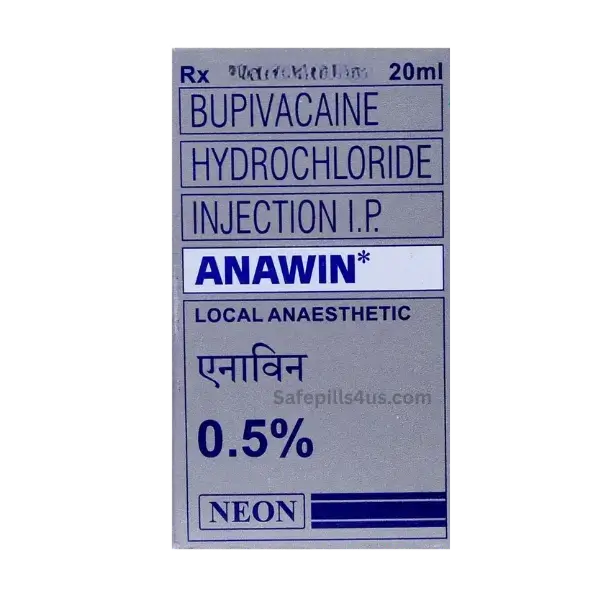
Anawin (Bupivacaine) is commonly used for:
- Regional anesthesia and nerve blocks (upper and lower limb, trunk blocks)
- Epidural anesthesia and analgesia (including postoperative and labor analgesia with appropriate concentrations)
- Spinal anesthesia (using the correct, preservative‑free, usually hyperbaric formulation when indicated)
- Infiltration anesthesia and field blocks for soft‑tissue procedures
- Caudal blocks in select adult and pediatric settings (specialist dosing only)
It’s chosen when a longer block is desired. Think several hours of numbness and comfort, not minutes.
Key Benefits
- Long duration: extended sensory block for prolonged procedures and postoperative pain control
- Predictable performance: stable onset and dense anesthesia when properly dosed and placed
- Flexible use: suitable for epidural, spinal, peripheral nerve, and infiltration techniques
- Sensory > motor: often a more pronounced sensory block, which can be helpful for pain control strategies
- Works with vasoconstrictor: compatible with epinephrine (where appropriate) to slow absorption and prolong effect
How It Works
Bupivacaine blocks voltage‑gated sodium channels in nerve membranes. When those channels are blocked, pain signals can’t travel. So the area goes numb. That’s it. No fancy tricks just steady nerve conduction blockade until the drug wears off.
Typical Onset & Duration
These are general ranges (actual times vary by site, dose, and technique):
- Onset: about 5–10 minutes for infiltration; 10–20 minutes for many peripheral nerve blocks; 5–8 minutes for spinal anesthesia
- Duration: roughly 2–8 hours for surgical anesthesia; analgesia may last longer. With epinephrine, duration often extends further
Concentrations & Administration
Note: Dosing is individualized by trained professionals based on site, technique, patient weight, and clinical status. Always follow product labeling.
- Common concentrations: 0.25% and 0.5% for infiltration and nerve blocks; specialized spinal use often employs 0.5% hyperbaric (heavy) formulations
- Maximum dose (general adult guidance; may differ by region/label): without epinephrine around 2.5 mg/kg (often not exceeding ~175 mg); with epinephrine around 3 mg/kg (often not exceeding ~225 mg). Always check the specific product insert you’re using
- Neuraxial use (epidural/spinal): requires preservative‑free solutions. For spinal, baricity matters hyperbaric preparations are used for level control
Important technique notes:
- Aspirate before injection and inject incrementally to reduce intravascular injection risk
- Continuous monitoring is required during and after administration
- Resuscitation equipment and 20% lipid emulsion should be immediately available in case of local anesthetic systemic toxicity (LAST)
Who Should Not Receive It
Avoid Anawin (Bupivacaine) in:
- Patients with known hypersensitivity to bupivacaine or other amide-type local anesthetics
- Severe shock, significant conduction abnormalities without pacer, or active coagulopathy where neuraxial techniques are contraindicated
- Intravenous regional anesthesia (Bier block) contraindicated due to cardiotoxicity risk
- Obstetric paracervical block contraindicated (risk of fetal bradycardia)
- Use of 0.75% solutions for obstetric anesthesia is generally contraindicated per many labels
Use with extra caution:
- Severe hepatic disease (impaired metabolism)
- Cardiovascular disease, conduction disorders, or reduced cardiac output
- Elderly, frail, or acutely ill patients
- Pediatric patients (specialist dosing and monitoring only)
Safety & Monitoring
What to watch for:
- Signs of intravascular injection or overdose: metallic taste, tinnitus, circumoral numbness, agitation, tremors, seizures, hypotension, bradycardia, arrhythmias, or cardiac depression
- Neuraxial risks: hypotension, bradycardia, high/total spinal if misplaced or overdosed
- Injection site effects: hematoma, infection, prolonged numbness, or nerve irritation (rare)
Preparedness matters:
- Continuous hemodynamic and respiratory monitoring during major blocks, epidural, or spinal anesthesia
- Immediate availability of airway support, seizure control (e.g., benzodiazepines), vasopressors, and lipid emulsion therapy for LAST
- Use the lowest effective dose and inject slowly, with frequent aspiration
Allergy notes:
- True allergy to amide local anesthetics is rare. Reactions are more often due to preservatives or vasovagal events. Use preservative‑free formulations for neuraxial techniques.
Interactions
- Other local anesthetics or Class I antiarrhythmics (e.g., lidocaine, mexiletine): additive toxicity
- Class III antiarrhythmics (e.g., amiodarone): theoretical increased cardiac depression monitor closely
- Epinephrine as an adjuvant: can prolong block and reduce systemic absorption; use only where appropriate and within safe limits
- Drugs that reduce hepatic blood flow or inhibit metabolism (e.g., some beta‑blockers, cimetidine): may increase plasma levels monitor for toxicity
- CNS depressants: additive sedation/respiratory depression risk when combined with heavy sedation or general anesthesia
Storage & Handling
- Store at controlled room temperature (refer to label for exact range)
- Protect from light where recommended
- Do not freeze
- Keep vials in outer carton until use
- Use aseptic technique; discard any unused portion of single-dose vials
- Keep out of reach of children. For professional use only
Practical Use Cases (Examples)
- Upper limb block (supraclavicular, infraclavicular) for orthopedic procedures needing sustained anesthesia
- Lower limb block (femoral, adductor canal, sciatic) with extended postoperative analgesia
- Epidural infusion for postoperative pain control after abdominal, pelvic, or lower-limb surgery
- Spinal anesthesia for lower abdominal, pelvic, urologic, or lower-limb procedures using the appropriate hyperbaric preservative‑free solution
- Infiltration anesthesia for soft‑tissue procedures where a longer effect is desirable
Important Safety Reminders (plain words)
- This is powerful stuff. It must be administered by trained clinicians only
- Inject slowly, keep talking to the patient, and keep a close eye on vitals
- If anything feels off (ringing in ears, funny taste, dizziness, slurred speech), stop and evaluate for early toxicity
- Lipid emulsion and full resus gear should be in the room not down the hall
Frequently Asked Questions (FAQs)
Q: What exactly is Anawin (Bupivacaine)?
A: It’s a long‑acting
local anesthetic used for
regional anesthesia,
epidural,
spinal,
nerve blocks, and
infiltration. It blocks pain signals in a targeted area for hours.
Q: How long does bupivacaine last?
A: It depends on the dose and block type, but expect several hours of anesthesia and often extended analgesia. With epinephrine, it can last even longer.
Q: Is it safe for labor epidurals?
A: With appropriate low concentrations and professional monitoring,
bupivacaine is commonly used for labor analgesia. High‑strength (e.g., 0.75%) solutions are generally contraindicated for obstetric anesthesia. Your anesthetist will choose the right formulation.
Q: Can it be used for a spinal?
A: Yes using the correct, preservative‑free, often hyperbaric formulation and dosing. Baricity helps control the level of anesthesia.
Q: Why pick bupivacaine over lidocaine?
A: Duration.
Bupivacaine usually lasts longer, which is great for extended procedures and postoperative pain control. Lidocaine often has a faster onset but wears off sooner.
Q: Can you add epinephrine?
A: Often yes (when appropriate). Epinephrine slows absorption from the injection site, which can prolong the block and reduce peak plasma levels. Not for end‑arterial fields (like fingers, toes, ears, nose, penis).
Q: What are the early signs of toxicity?
A: Metallic taste, tinnitus, tingling around the mouth, dizziness, confusion, or twitching. Severe cases can cause seizures or cardiac depression. This is why monitoring and incremental dosing matter.
Q: Is bupivacaine safe in kids?
A: It can be, but pediatric dosing is specialized. Only trained pediatric anesthesia teams should administer it.
Q: Any allergy concerns?
A: True allergy to amide anesthetics is rare. If neuraxial use is planned, preservative‑free solutions are used to reduce risks.
Q: Can I go home right after a block?
A: Your team will decide. You’ll need to recover sensation and motor strength and meet discharge criteria. Numb limbs can increase fall risk take it slow.
Q: Does Anawin contain preservatives?
A: That depends on the specific pack. For
epidural and
spinal anesthesia, clinicians use preservative‑free formulations. Always check the vial label.
Q: Can it be used for a Bier block (IVRA)?
A: No.
Bupivacaine is contraindicated for intravenous regional anesthesia due to cardiotoxicity risk.


Reviews
There are no reviews yet.